

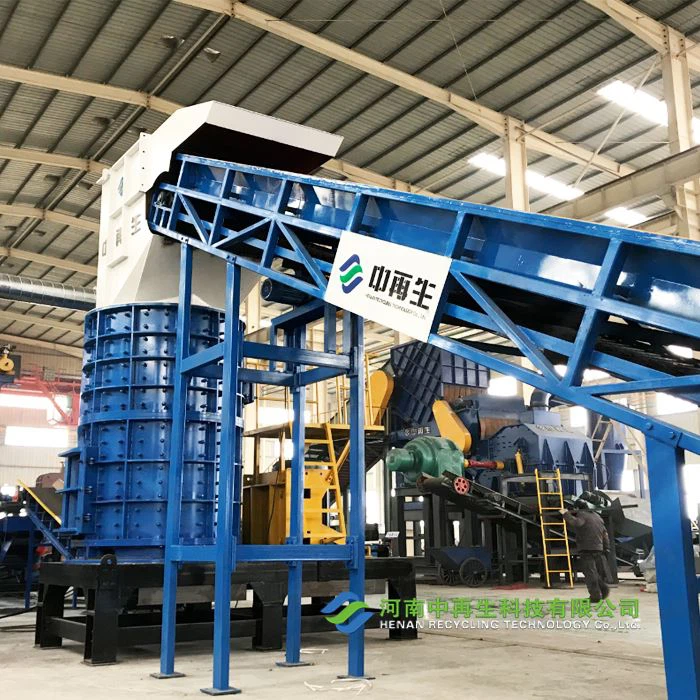
Vertical Hammer Shredder
A vertical hammer shredder is a type of industrial shredder that grinds and shreds large materials, such as wood, plastic, metal, and rubber, into smaller pieces or particles. It has a vertical rotor that contains hammers or blades that spin at high speeds to break down the materials. The shredded material can then be recycled or processed further for other applications.
Advantages of Vertical Hammer Shredder
Versatility
A hammer mill can grind and crush different types of materials at high angular velocity. It can be used for primary, secondary, or tertiary grinding, and size reduction of materials can happen dynamically.
High reduction ratio and capacity
Regardless of whether it is used for primary, secondary, or tertiary grinding, a hammer mill offers high reduction ratios and capacity. This means that it can efficiently reduce the size of materials and handle large quantities of material.
Minimal risk of contamination
Hammer mills do not use knives, blades, hammers, milling media, or screens, which means there is minimal risk of contamination from worn mill parts. This is important for applications where contamination needs to be avoided, such as in the cosmetics industry.
Easy to clean
The simple chamber design of a hammer mill makes it easy to clean, reducing the risk of cross-contamination. Unlike mechanical mills, there is no temperature change due to grinding, which is important for heat-sensitive materials.
Choice of hammers
Hammer mills can use either hard or soft hammers. Hard hammers impact the material with a flat surface, leading to greater particle size reduction and wider particle size distribution. Soft hammers use sharp, knife-like edges to slice apart the material, achieving less particle size reduction but a narrower particle size distribution.
Overcoming non-friable materials
One potential drawback of using a hammer mill is when the material itself is not intrinsically friable, meaning it won't easily crack under the application of force. However, intrinsically friable materials usually have microscopic defects, like fractures or gaps, which act as natural places along which cracks can propagate, allowing the material to break apart.


Why Choose Us
High quality products
We always put customer needs and expectations in the first place, refine on, continuous improvement, to seek every opportunity to do better, to provide customers with their expectations of quality products, to provide customers with the most satisfactory service at anytime.
Quality Control
All goods will undergo strict quality inspection before shipment. MCC always insists on providing high-quality products. We firmly believe that quality is the basis of everything.
Professional team
We have a team of skilled and experienced professionals who are well-versed in the latest technology and industry standards. Our team is dedicated to ensuring that our customers get the best service and support possible.
Competitive prices
We offer our products at competitive prices, making them affordable for our customers. We believe that high-quality products should not come at a premium, and we strive to make our products accessible to all.
Rich experience
Has a long-standing reputation in the industry, which makes it stand out from its competitors. With over many years of experience, they have developed the skills necessary to meet their clients' needs.
Efficient and convenient
The company has established marketing networks around the world to provide high-quality services to customers in an efficient and convenient manner.
This report offers past, present as well as future analysis and estimates for the Vertical Spindle Hammer Crusher Market. The market estimates that are provided in the report are calculated through an exhaustive research methodology. The research methodology that is adopted involves multiple channels of research, such as – primary research, secondary research, and subject-related expert advice. The market estimates are calculated based on the influence of the current market dynamics along with various economic, social, and political factors on the Vertical Spindle Hammer Crusher Market. Also, various regulations, government spending, and research and development growth define the market data. Both positive, as well as negative changes to the market, are taken into consideration for the market estimates.

Hammer Crusher Structure & Parts
Shell
The shell is composed of the lower body, the upper rear cover, the left and the right side walls. Each part is connected by bolts. A feeding port is set on the upper part. The inner part of the shell is made of manganese steel, which can be replaced after being worn. The lower body is welded by steel plates in order to place the bearing to support the rotor on both sides of the lower body. A shaft seal device is arranged between the casing and the shaft to prevent ash leakage.
Rotor
The crusher rotor is composed of main shaft, hammer holder, and pin shaft. The hammer is suspended on the hammer holder in eight rows by the pin shaft. In order to prevent the axial movement of the hammer frame and the hammer head, both ends of the hammer frame are fixed with a compression disc and a lock nut. In addition, in order to make the rotor store a certain amount of kinetic energy in motion, a flywheel or large pulley should be installed at one end of the main shaft.
Main Shaft
The main shaft is the main part supporting the rotor, which needs to bear the mass and impact force from the rotor and hammer head in the process of operation, so its material must have high strength and toughness.
Hammer Holder
The hammer holder is used to hang the hammer heads. Although it does not directly participate in the process of crushing materials, it is still subject to the impact and friction of ore and wears, so it should be made of materials with good wear resistance.
Hammer
The hammer heads are the core part of a hammer crusher. The weight, shape, and material of hammer heads affect the production capacity of the crusher significantly. The heavier the hammer, the more kinetic energy it possesses, and the higher the crushing efficiency. But heavy hammer also causes more damage to other parts and accelerate their wear process. The hammer weight should be able to balance the production efficiency and the wear rate.
Grate
The arrangement of grate bars of the hammer crusher is a circular arc that is perpendicular to the moving direction of hammerhead and has a certain clearance with the rotary radius of the rotor. The material smaller than the gap between grate bars can pass through the gap, and the material larger than the gap will be continuously impacted, ground and broken by the hammers until it can pass through the gap. Due to the impact of hard materials and metal blocks, the grate is easy to bend and break, so it needs to be inspected and replaced frequently.
Lining Plate
The lining plate is installed inside the shell to protect it from the ore. The lining plate is cast of high manganese steel, the same material used for the grate bar and hammer. The lining plate can be replaced when it is seriously worn to ensure product quality.
Types of Hammermill Shredder
In these hammer mills, the swinging hammers are mounted on a shaft. The particle size reduction takes place by hammering application, as well as by particle on particle force. The discharge in these mills is subjected to gravity and is from the bottom, therefore are called bottom discharge or gravity discharge hammer mills. These mills are used for crushing glass, dry chemicals, ceramics, etc.
The hammering function of pneumatic hammer mills is similar to gravity discharge mills despite the fact that chamber walls and hammers are thin. However, this type has a plate dashboard that contributes to size reduction. In this type, the discharge is assisted by the air evacuation process to enhance overall output. These hammers are used for lighter material such as paper, biomass, greenwood, etc.
These industrial hammers feature a 300-degree rotating screen that improves particle evacuation. It is suitable for lightweight components, which do not require initial grinding. These mills are used for hammering spices, grasses, etc.
These hammer mills are designed to insert the material from the side, not from the top. These mills are aggressive in function, therefore, are used for heavy particle grinding. Trim scrap grinders and pallet grinders are featured in these hammer mills to perform hardcore industrial grinding.
Lump breaker is by design and functionally very different from other hammer mills. In this type, there are no swinging hammers but it features a small fixed hammer structure on the shaft. The purpose of this hammer mill is not to reduce the particle size but to smoothen the powder or paste. The hammer structure on the shaft is called comb. The particles are made to pass through the comb to achieve the desired particle size. These hammer mills are used for sugar, dry chemicals, cement, etc.
Main Components of a Hammer Mill Machine
The Feeding Mechanism of Pulverizer Hammer
This alludes to the procedure by which particles enter the crushing chamber. Contingent upon the design of the hammer mill machine, it might utilize gravity or a metered feeding system.Metered feeding systems are regular in applications where item consistency is a significant concern. They get rid of every conceivable variable that may cause yield item irregularities.The best example that we can use the pneumatic turning valve found between the feeding container and the crushing chamber.In the gravity feeding system, the milling machines exclusively rely upon the gravitational force. It is this force assists with feeding particles into the crushing chamber.
Control box of Pulverizer Hammer
It is called the brain of a Hammer Mill. It controls all the activities that take place inside the mill. It also serves as an interface between the operator and the machine.The control box comes in different designs and operational parameters. Through this panel, you can control the speed at which the mill crushes the material.The panel has a display box through which you can monitor the performance and operation of a hammer mill.
Crushing hammers/Knives
These are the components that do the actual crushing of the material. The hammers rotate at high speed ranging from 2000 to 6000 rpm. can control the speed of rotation through the control panel. By and large, these hammers are mounted on horizontal shafts where they may rotate either clockwise or anticlockwise. This may rely upon the course of the rotor turn. A rotor is the turning shaft coupled to an electric engine. The hammers come in various styles and shapes. The tools for a hammer mill might be coupled legitimately to an engine or driven by a belt. Instead of direct connection, the belts can protect the engine from stun and takes into consideration precise speed modification.
Hammer Mill Pulverizer Screens
After the pharmaceutical food or chemical raw materials has been crushed, the next thing is to collect them in readiness for the next production stage. It will have to pass through the screens where it will be filtered. The size of the crushed particles will depend on the types of screens. These screens are systematically arranged to ensure that you get the desired sizes of the particles.
Screen
The screen chicken feed granules are made of stamped steel sheet or iron sheet. Overhaul is required when the screen is worn or punctured by foreign matters. If the damaged area is not large, it can be repaired by riveting or welding. If the damaged area is large, replace the screen with a new one. When installing a new screen, pay attention that the rough surface of the screen hole faces inward and the smooth surface faces outward, and the screen mesh and the screen frame are close. When installing the ring net, make the stubble follow the rotation direction to prevent blocking at the overlap.
Bearing
The bearing of the feed grinder shall be cleaned once every 300 hours of operation. If the bearing is lubricated with engine oil, it is recommended to fill 1 / 3 of the bearing seat clearance and not more than 1 / 2 when adding new engine oil. Tighten the constant cover oil ring cover slightly before operation. When the bearing of feed mill is seriously worn or damaged, it shall be replaced in time and lubrication shall be strengthened.
Crushing claw
Among the components of the claw type feed crusher, the crushing claw is a vulnerable part, and is also the main component that affects the feed crushing quality and production efficiency. Therefore, the crushing claw should be replaced in time after wear. When replacing the jaws, pull out the disc first. It should be noted that before pulling out the disc, the round nut lock plate on the back of the disc must be opened, the round nut is screwed out with a hook wrench, and then the disc is pulled out with a special puller. To ensure the balanced operation of the rotor, pay attention to complete replacement when replacing the claw parts. When assembling the claw, be sure to tighten the oyster nut, and be careful not to miss the spring washer. In addition, qualified parts shall be selected for jaw replacement,
Hammer
Some hammer pieces of the hammer type feed grinder are symmetrical. When the acute angle of the hammer piece becomes blunt, the angle can be adjusted on the opposite side; If one end and two corners are worn, turn them over. When adjusting the angle or rotating the head, all hammers shall be operated at the same time; After the four corners of the hammer head are worn, all the hammerheads shall be replaced. The weight difference of each group of hammerheads shall not exceed 5g. In addition, the pin shaft of the fixed hammer and the circular hole of the mounting pin shaft will be gradually ground due to wear, and the circular hole will gradually become larger. When the diameter of the pin is 1mm less than the original size, the diameter of the round hole will be ground to the original size. When it is 1 mm larger.
Our Factory
Since Our Factory Was Founded, We Started To Make Scrap Metal Recycling Equipment. And Rapidly Developed Into China's Top Three Waste Metal Recycling Processing Equipment Bases.We Are Dedicated To The Research, Development, And Manufacturing Of Recycling Equipment As Well As Integrated Solutions Supplier.


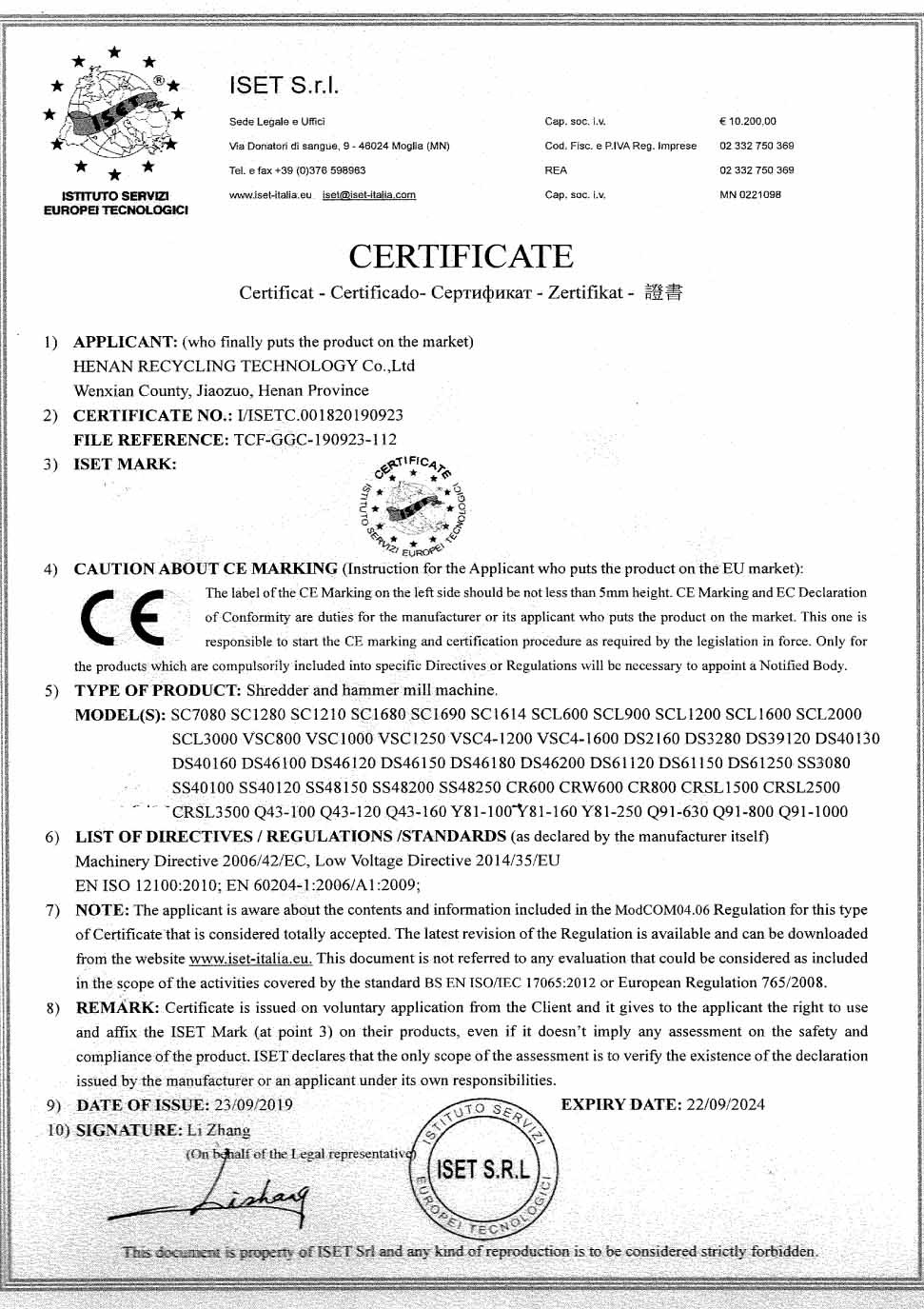
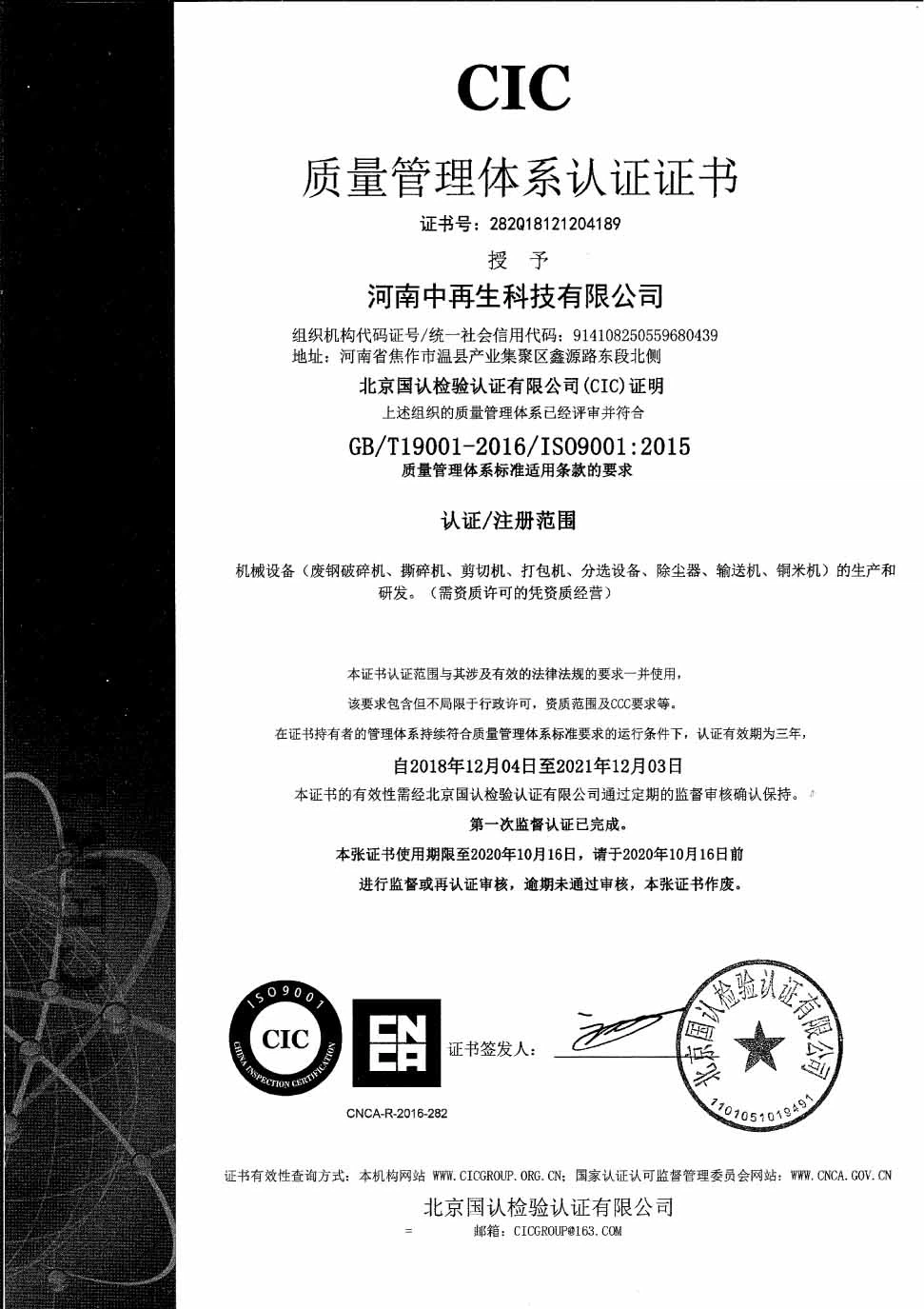
Certifications

FAQ
We're well-known as one of the leading vertical hammer shredder manufacturers and suppliers in China. Please feel free to buy high quality vertical hammer shredder for sale here from our factory.